Java中的thread.interrupt()方法和linux中的kill -9命令有着本质的区别。 interrupt()方法的唯一作用是: 设置一个标志位
至于线程是立刻停止,稍后停止,还是完全无视这个信号,完全取决于线程内部的代码逻辑。
三种使用场景
场景A 线程处于阻塞状态
如果线程正在执行sleep(),wait()和join()等阻塞方法(会让线程进入TIMED_WAITING状态),调用interrupt()会抛出InterruptedException异常。
重要细节:抛出异常的同时,中断标志位会被自动清除(置为 false)。
场景B 线程处于运行状态
如果线程正在正常运行(RUNNABLE状态),调用interrupt()不会抛出异常,而是将中断标志位设置为 true。
此时,线程需要在适当的地方检查这个标志位,以决定是否应该停止执行。
场景C IO阻塞
- 传统的IO阻塞(如InputStream.read())不会响应interrupt(),线程会继续阻塞,直到IO操作完成。
- NIO (New IO) 的 SocketChannel 等是支持中断的,会抛出 ClosedByInterruptException。
实战演示
打断sleep中的线程
package demo;
import java.util.concurrent.TimeUnit;
import java.util.concurrent.TimeUnit;
public class InterruptSleepDemo { public static void main(String[] args) throws InterruptedException { Thread t1 = new Thread(() -> { try { System.out.println("T1: 我准备睡 10 秒..."); TimeUnit.SECONDS.sleep(10); System.out.println("T1: 睡醒了 (但这句通常不会执行)"); } catch (InterruptedException e) { // 捕获异常,响应中断 System.out.println("T1: 谁打扰我睡觉!(检测到中断异常)"); // 此时 flag 已经被 JVM 清除了 } });
t1.start();
// 主线程歇 1 秒,确保 t1 已经睡着 TimeUnit.SECONDS.sleep(1);
System.out.println("Main: 我要打断 T1"); t1.interrupt(); // 拍拍 T1 的肩膀 }}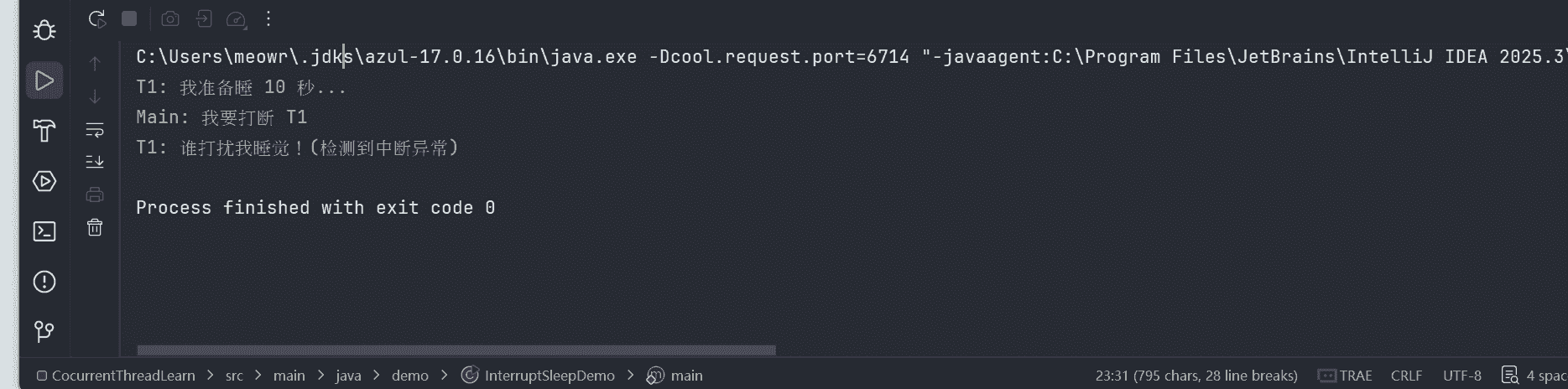
中断“跑着”的线程 (需要配合检查)
package demo;
import java.util.concurrent.TimeUnit;
import java.util.concurrent.TimeUnit;
public class InterruptSleepDemo { public static void main(String[] args) throws InterruptedException { Thread t1 = new Thread(() -> { while(!Thread.currentThread().isInterrupted()) { System.out.println("计算中"); } System.out.println("收到终止信号,结束线程: " + Thread.currentThread().getName()); });
t1.start();
// 主线程歇 1 秒,确保 t1 已经睡着 TimeUnit.SECONDS.sleep(1);
System.out.println("Main: 我要打断 T1"); t1.interrupt(); // 拍拍 T1 的肩膀 }}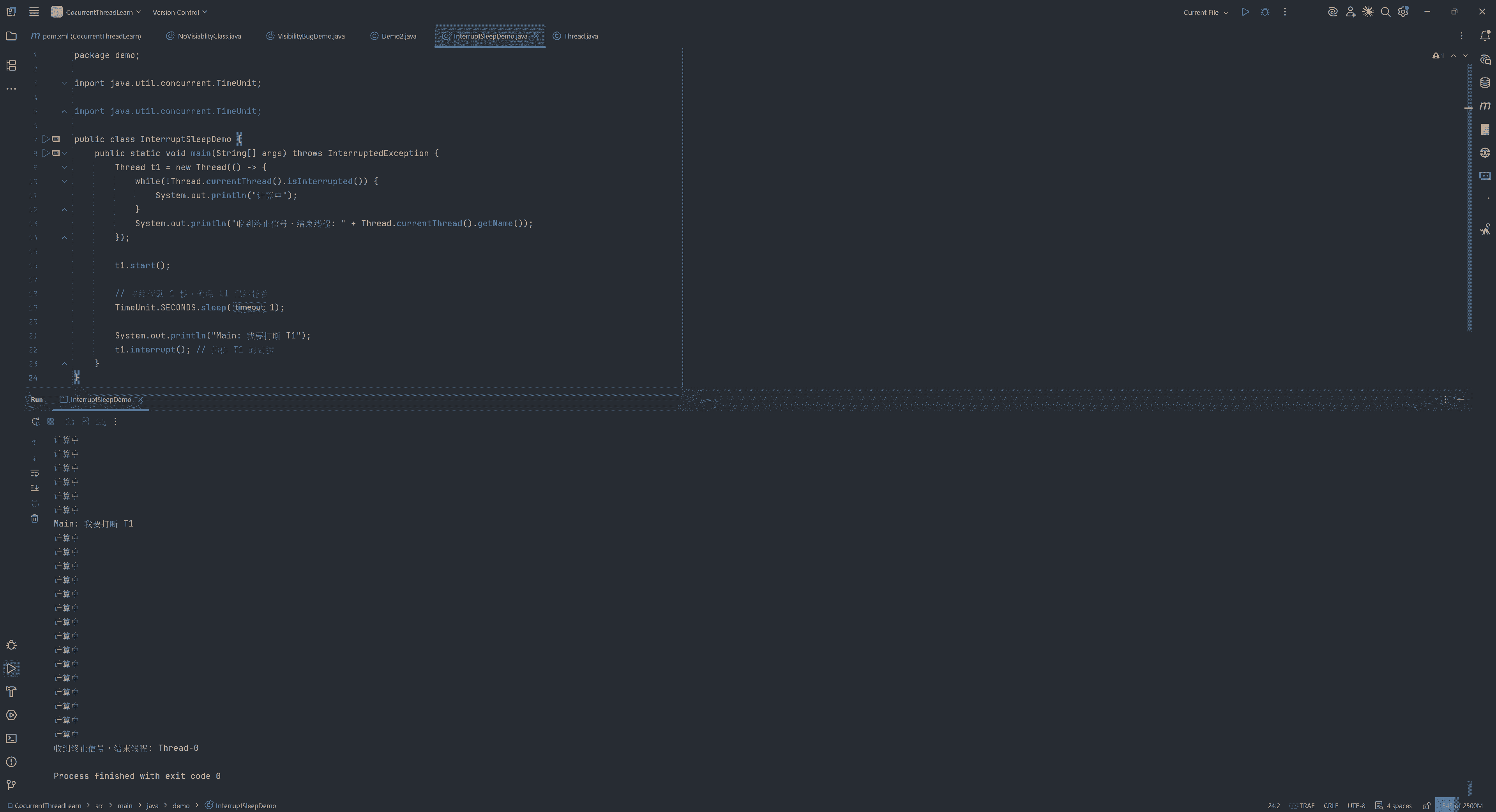
两阶段终止
先看第一版代码:
package demo;
import java.util.concurrent.TimeUnit;
import java.util.concurrent.TimeUnit;
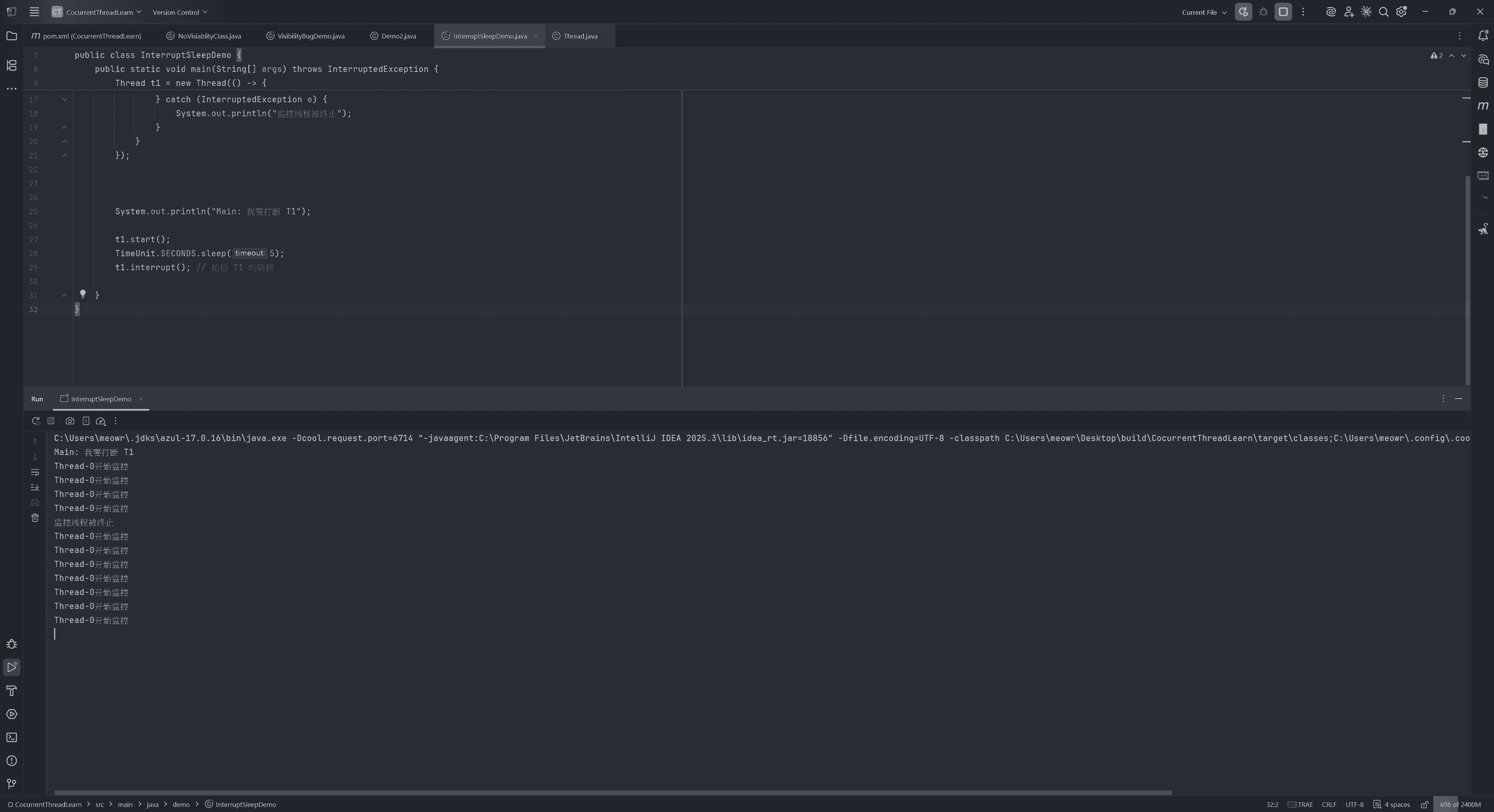
public class InterruptSleepDemo { public static void main(String[] args) throws InterruptedException { Thread t1 = new Thread(() -> { while (true) { if(Thread.currentThread().isInterrupted()) { break; } try { TimeUnit.SECONDS.sleep(1); System.out.println(Thread.currentThread().getName() + "开始监控"); } catch (InterruptedException e) { System.out.println("监控线程被终止"); } } });
System.out.println("Main: 我要打断 T1");
t1.start(); TimeUnit.SECONDS.sleep(5); t1.interrupt(); // 拍拍 T1 的肩膀
}}这里的缺陷是:当 t1 在 sleep 中被打断时,抛出 InterruptedException 异常后,线程会继续执行 while 循环,导致监控线程无法正常结束。
为什么呢?因为抛出异常后,线程的中断标志位会被 JVM 自动清除(置为 false),所以 while 循环中的 isInterrupted() 永远返回 false,线程就一直在监控。
我们改一下
package demo;
import java.util.concurrent.TimeUnit;
import java.util.concurrent.TimeUnit;
public class InterruptSleepDemo { public static void main(String[] args) throws InterruptedException { Thread t1 = new Thread(() -> { while (true) { if(Thread.currentThread().isInterrupted()) { break; } try { TimeUnit.SECONDS.sleep(1); System.out.println(Thread.currentThread().getName() + "开始监控"); } catch (InterruptedException e) { System.out.println("监控线程被终止,当前interrupted状态: " + Thread.currentThread().isInterrupted()); System.out.println("手动设置为已终止状态,让这个循环能正常退出"); Thread.currentThread().interrupt(); System.out.println("档期那监控线程interrupted状态:" + Thread.currentThread().isInterrupted()); } } });
System.out.println("Main: 我要打断 T1");
t1.start(); TimeUnit.SECONDS.sleep(5); t1.interrupt(); // 拍拍 T1 的肩膀
}}这里的 Thread.currentThread().interrupt(); 是为了在捕获 InterruptedException 异常后,手动将线程的中断标志位重新设置为 true,这样 while 循环中的 isInterrupted() 就能正确地检测到中断信号,从而正常退出循环,结束线程。
这就是两阶段终止的典型实现:第一阶段通过 interrupt() 发出终止信号,第二阶段在线程内部通过检查中断标志位来决定何时真正结束线程。
发现错误或想要改进这篇文章?
在 GitHub 上编辑此页RSS / 网站地图
由 Astro 和 Fuwari 强力驱动
本网站代码 已开源 (4561fb4 @ 2026-10-11 21:22:18)
 晋ICP备2025071728号-1
  晋公网安备14060202000213号